Define the outcome
Requirements hold the statement, acceptance criteria, owner and priority. Keep amendments as versions, connect delivery tasks, and distinguish enhancements, feature requests and change requests.
From the first requirement to the next review. Explore the work, conversations, documents and insights that help your team move forward together.
Give every customer a clear path from sign-up to their first project.
Acceptance criteria, agreedThe requirement, the work and the next step.
Define what you need to deliver, organize the parts of the product and choose the next delivery window. Requirements, modules and cycles give everyone the same starting point.
Start with tasks when that is enough. Bring in the richer planning model as the project grows.
PDF and CSV match the report.
Requirements hold the statement, acceptance criteria, owner and priority. Keep amendments as versions, connect delivery tasks, and distinguish enhancements, feature requests and change requests.
Modules organize a capability or product area. Group related requirements and work so a team can see the part of the product it owns.
Use sprints, phases, milestones or versioned releases. See dates, status, progress and the tasks included in each cycle.
A real Keep requirement with its statement, acceptance criteria, owner and details rail, followed by versions, delivery tasks, modules and cycles.
Recorded in Keep with sample data. Silent video.
Continue to Work
Turn the plan into tasks, bugs and chores. Give the work an owner, make blockers visible and keep each handoff connected to the reason it exists.
Choose the view that helps today: a focused list, a Kanban board or a Gantt timeline.
Your agent can pick up the work and leave the handoff. Your team sees what changed, even when you haven’t opened Keep.
Move between list, Kanban and Gantt. Filter the work, open a quick preview and keep the wider project in view.
Tasks, bugs and chores have owners, priorities and due dates. Subtasks and blockers explain what can move and what is waiting.
Trace a task to its requirement, cycle and supporting records. Your team and connected agents work with the same project context.
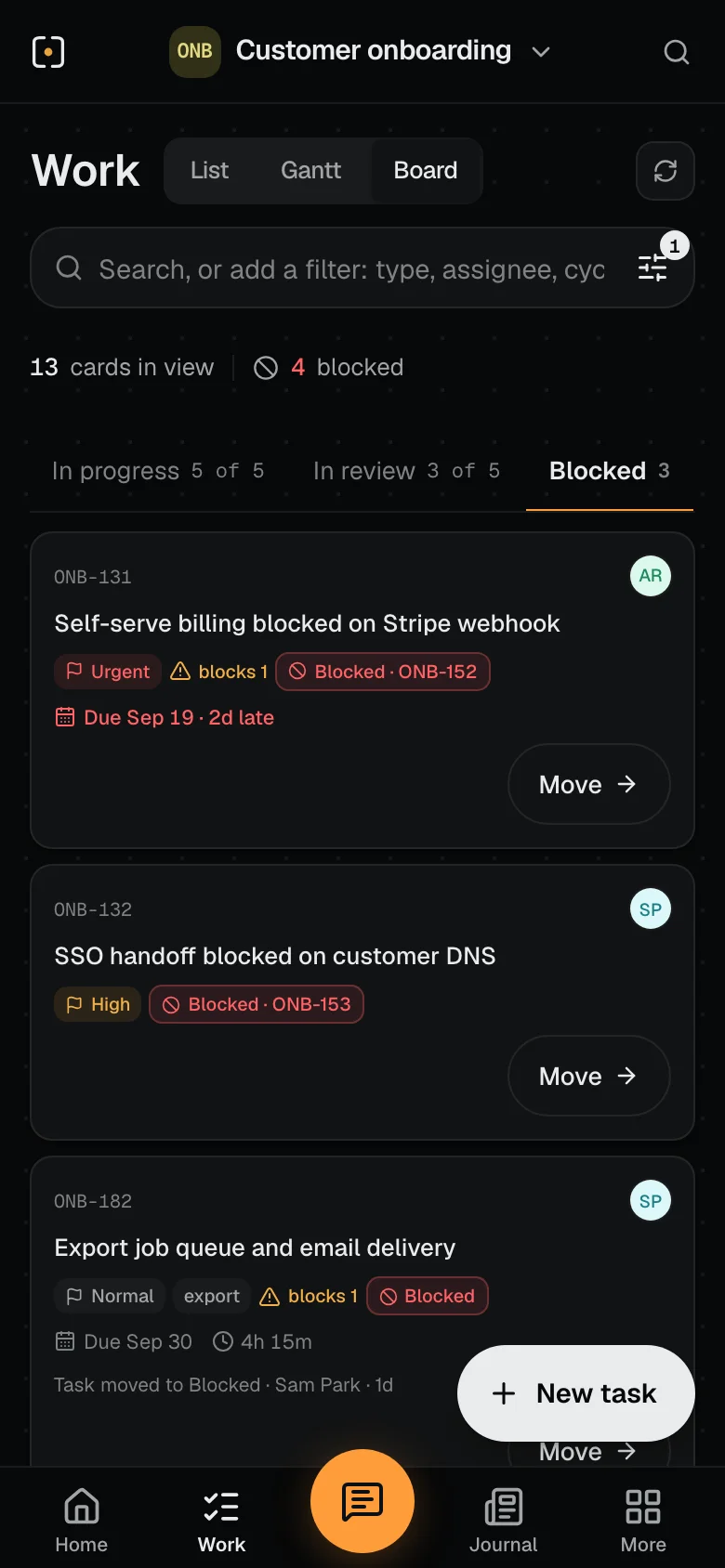
The real Keep Kanban board showing in-progress, review, blocked and done cards for Customer onboarding.
Recorded in Keep with sample data. Silent video.
Continue to Mobile
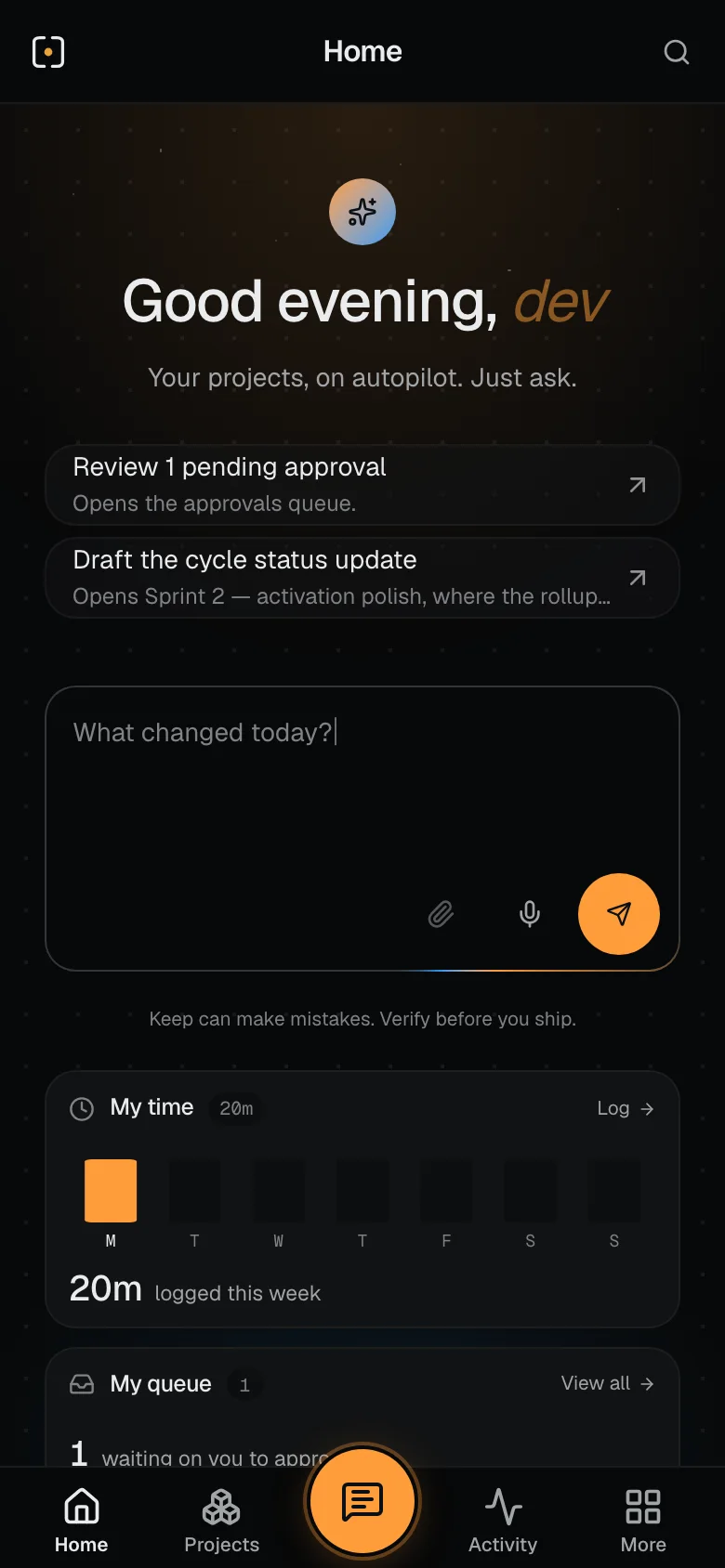
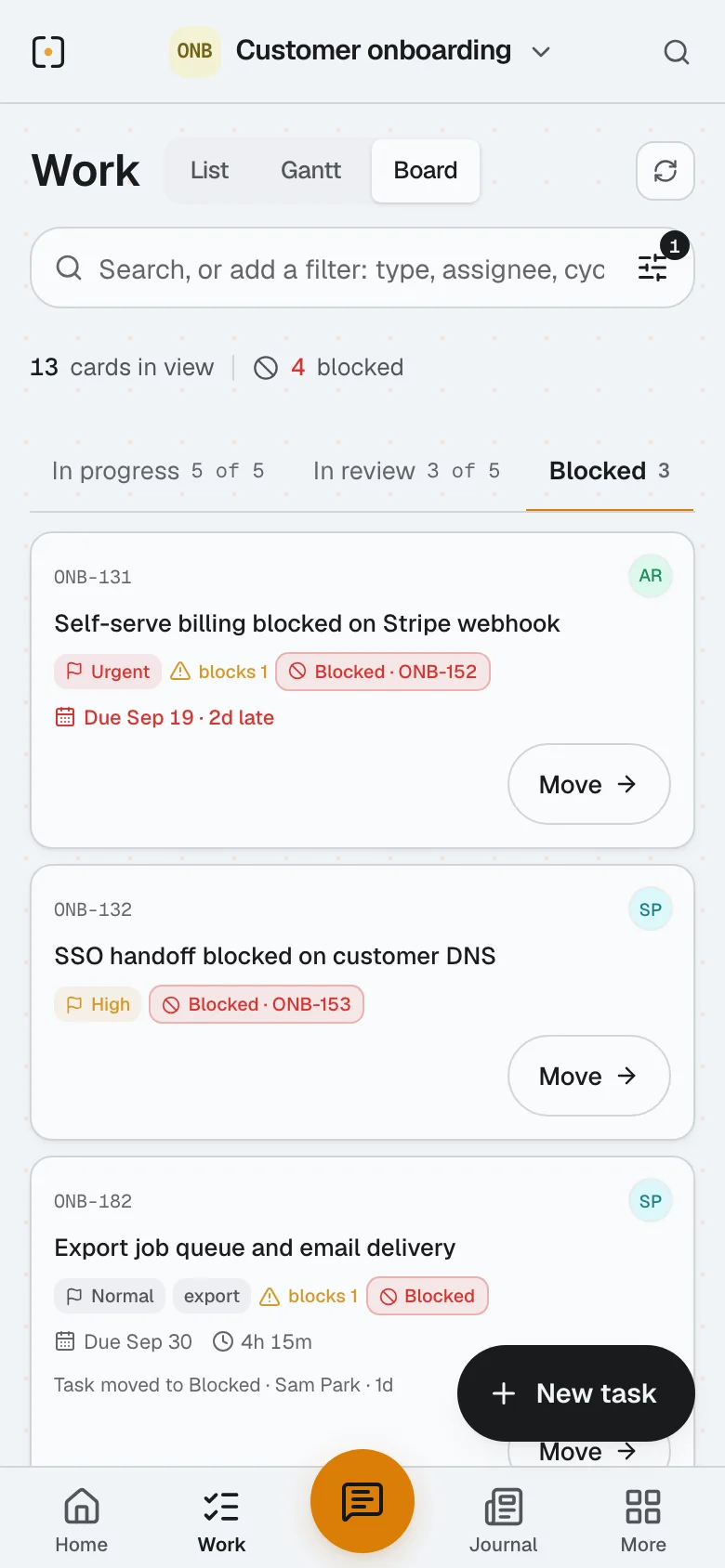
It is the same workspace you open in a browser, laid out for one thumb.
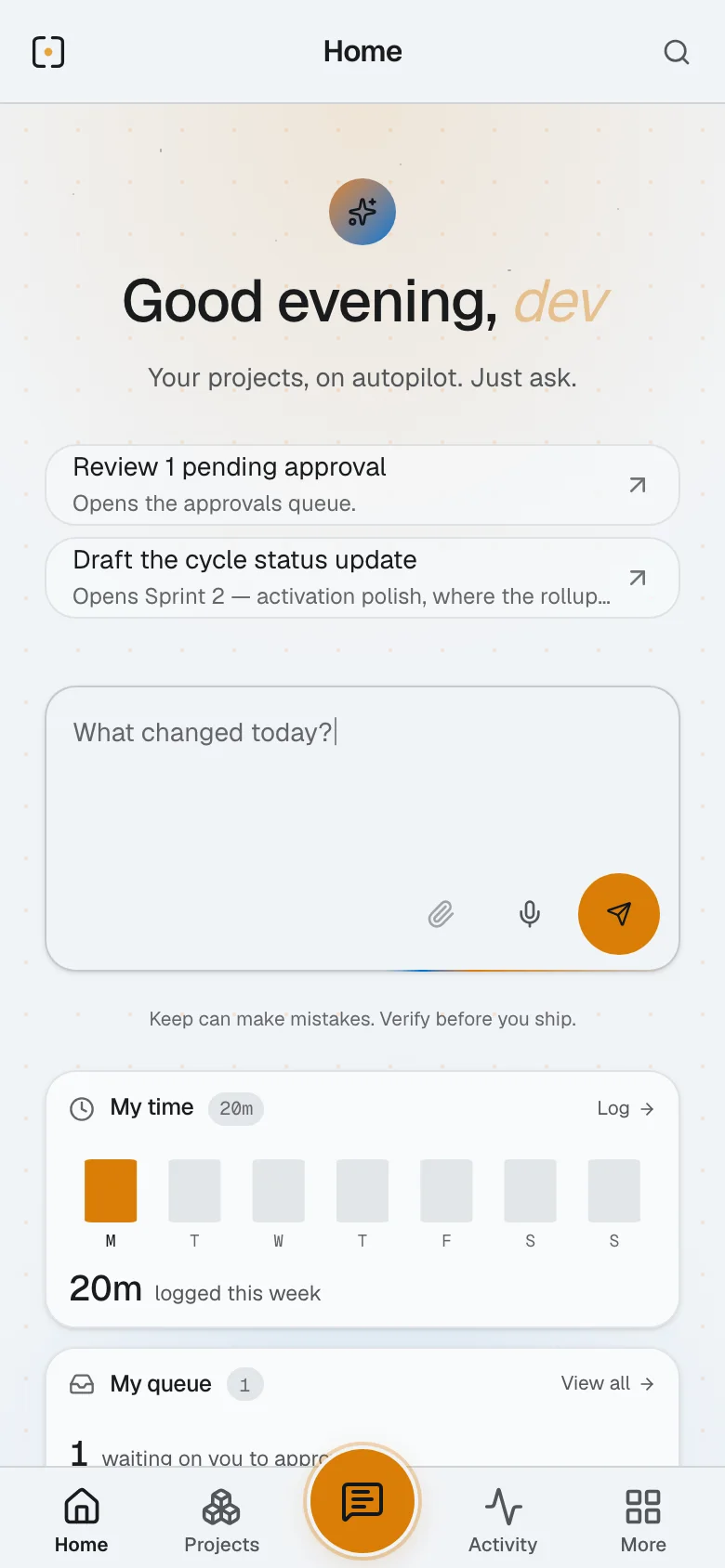
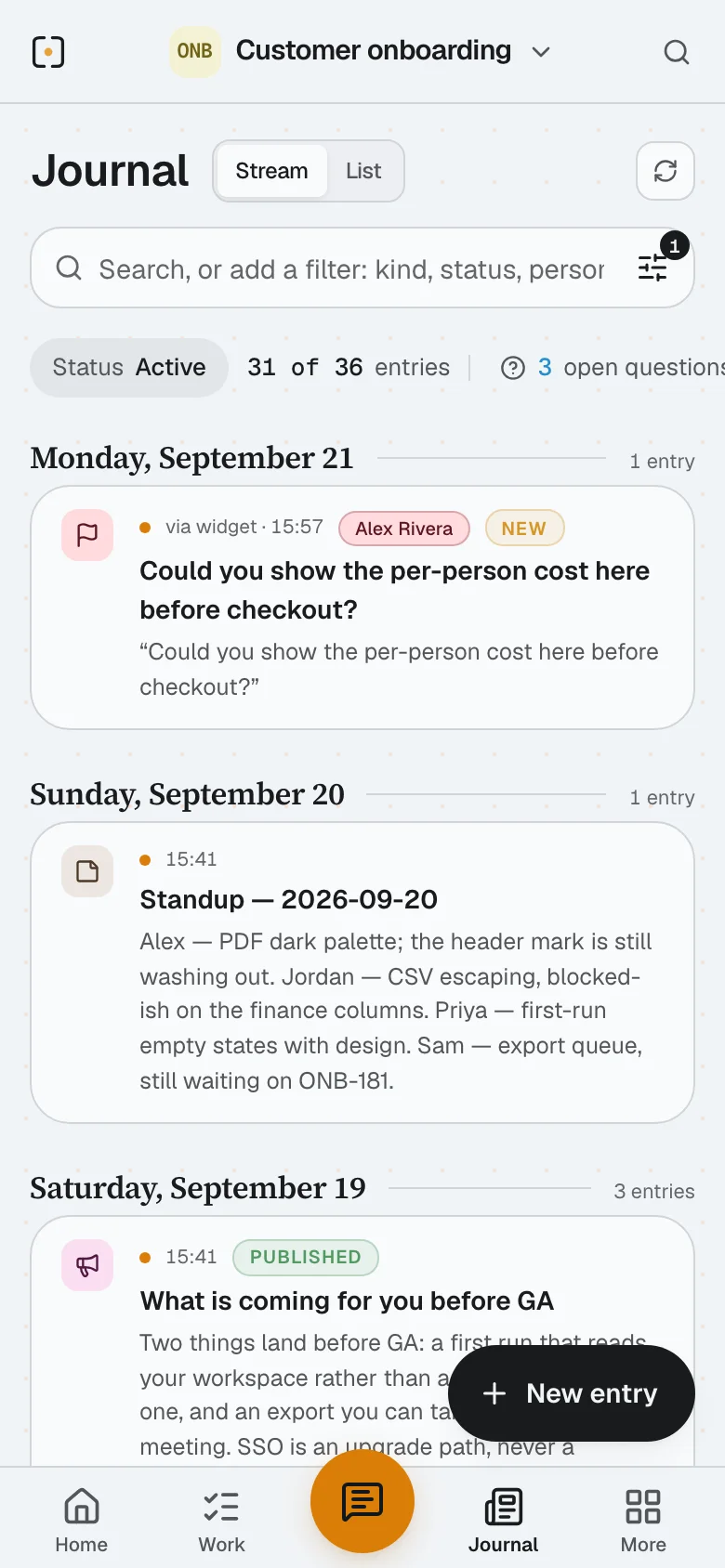
Your queue, the hours you have logged and the approvals waiting, without opening a laptop.
Open a card, change its state, leave a reply or log the time you just spent.
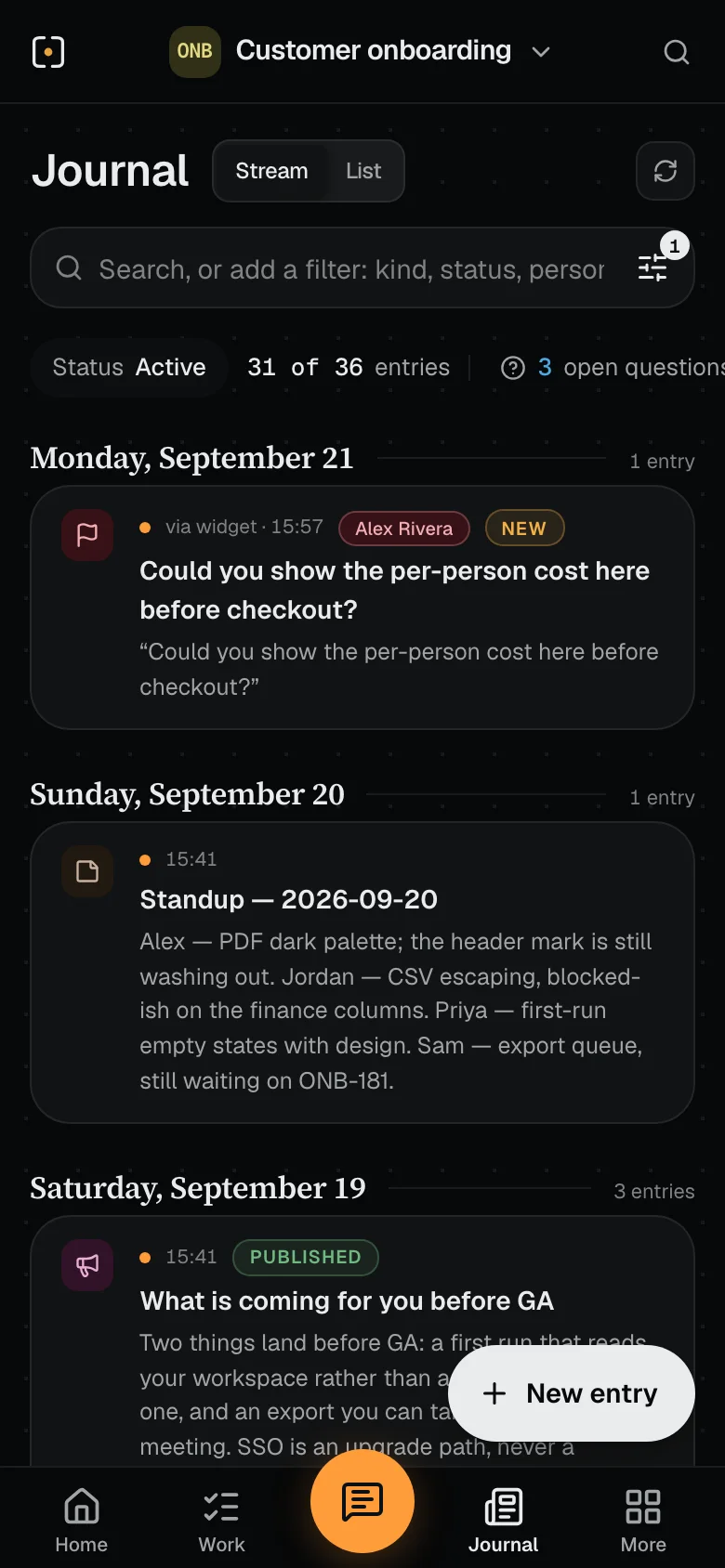
The journal in one column: decisions, updates, questions and feedback as they land.
The board gives you one lane at a time, each card with the move it needs. Check your queue, change a state, leave a reply or log the time you just spent.
Continue to Journal
A project is more than its task list. Keep the decisions, notes, questions, risks, feedback and updates that explain how you got here.
Stream turns those distinct records into a readable story, with the connections still attached.
Notes keep the observation. Decisions keep the choice and rationale. Updates share progress; questions and risks keep the unresolved work visible.
Follow dated entries, open the detail and explore linked records. Feedback and meeting outcomes stay alongside the work they explain.
Journal Stream shows dated project updates, decisions and questions beside the story-so-far summary.
Recorded in Keep with sample data. Silent video.
Continue to Artifacts
Give documents, files and finished work a place to live. Keep artifacts independently in Docs, organize a collection or bring them into a project.
Share the work with the people who need it, including people who do not use Keep.
Explore documents and sharingA clear starting point for the team.
Document · v3Write Markdown documents, upload PDFs and other files, save links, or preview HTML and JSX. Artifacts can live in Docs independently or belong to a project.
Use collections and document versions to keep the working material and finished output together. Connect an artifact to the records it supports.
Create links with optional passwords and expiry, and revoke them when needed. A public artifact link needs no Keep login; Google embeds retain Google permissions.
Customer onboarding artifacts displayed as document, file, link and embed preview cards.
Recorded in Keep with sample data. Silent video.
Continue to Feedback Agent
A visitor points to an element, annotates the screenshot and sends feedback from your website. No Keep login needed.
Your team gets the page context and the next conversation. The visitor can return to their own report and status.
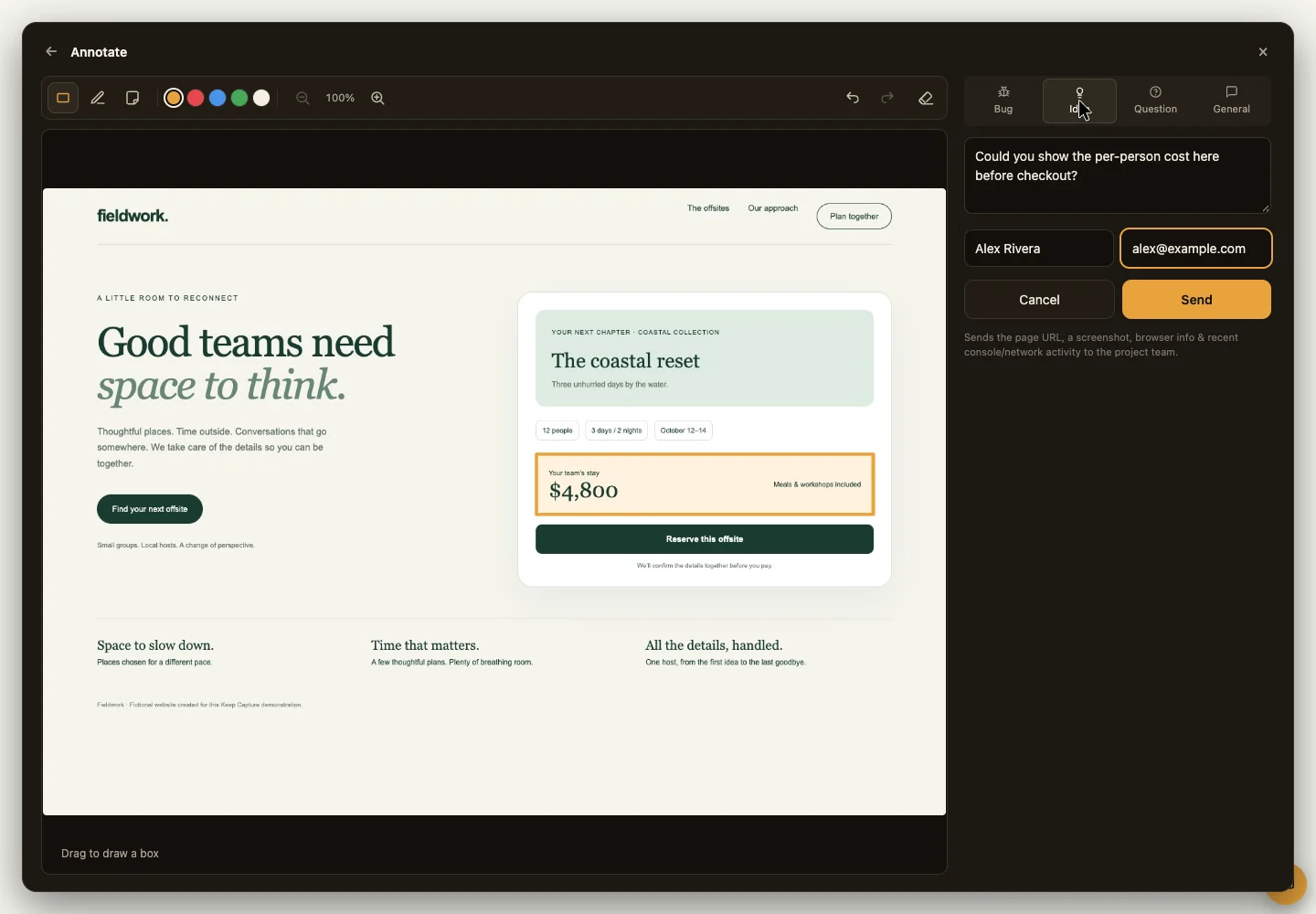
See the widget and installation guide“Could you show the per-person cost before checkout?”
Idea · Screenshot attachedDrop the widget into your website. Select an element, capture the page and annotate the screenshot so the team can see the issue.
Send a bug, idea or question without a Keep login. Page context and the screenshot arrive with the report.
The reporter can revisit their own submissions and status in the same browser. Your team can connect the requirement or follow-up work.
The real Keep Capture annotation editor with a box around a price on a fictional booking website and an idea ready to submit.
Recorded in Keep with sample data on a fictional website. Silent video.
Continue to Time
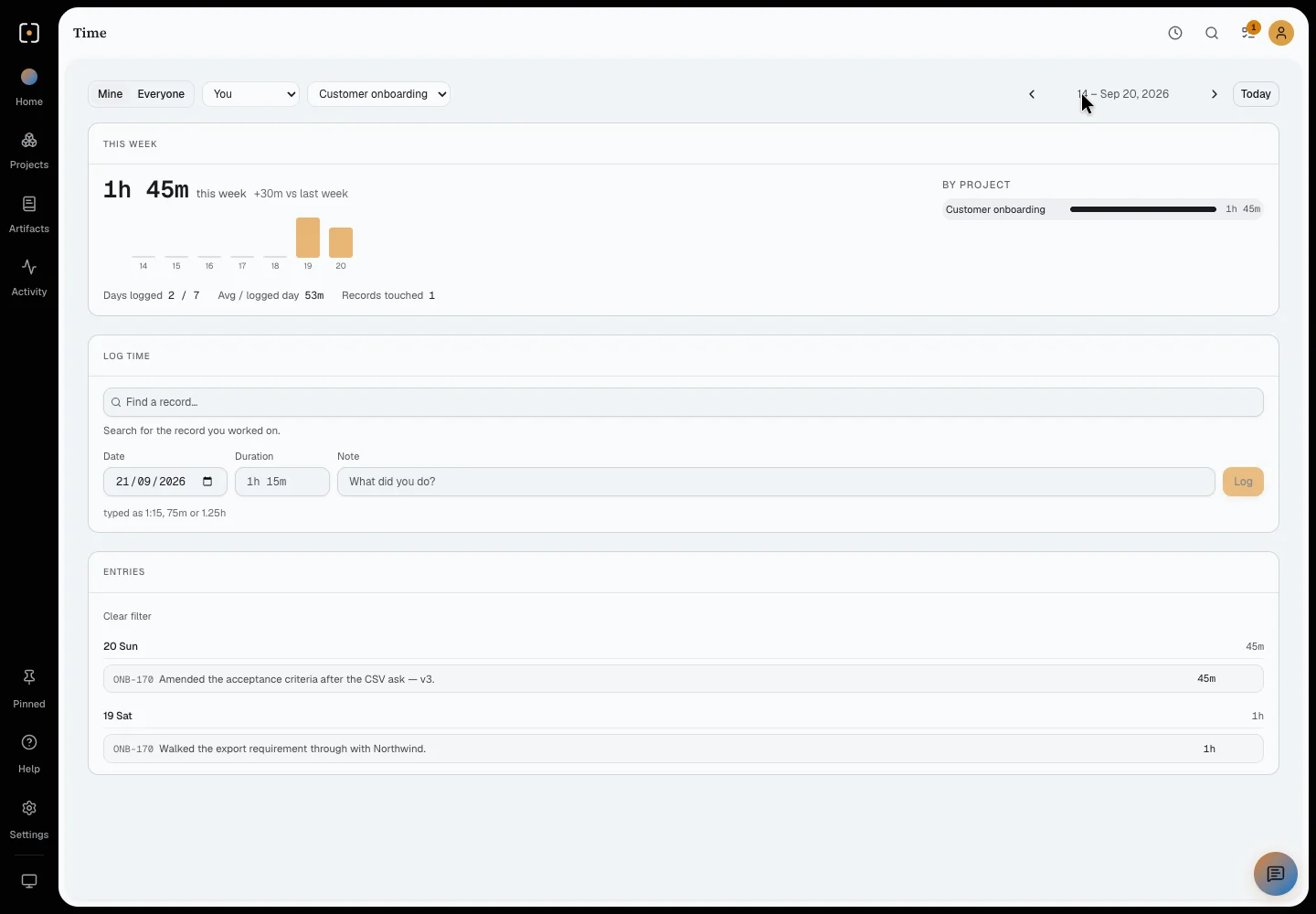
Start with the My time widget on Home. Open your week, see where the hours went and follow an entry back to the work.
Log time yourself or let a connected working session record it. Your own time and the wider project each have a view.
9h 30mlogged this week
Open My time from the Home widget. See your weekly total, daily bars, days logged and the projects you spent time on.
Enter a duration and note against a record. The Keep plugin can also meter an active work session, with checkpoints and pauses. Both record your time against the work.
Move between weeks, narrow by project and open the record behind an entry. Team views and the Time report give a broader reading where your permissions allow.
Keep’s My time page with a seven-day bar chart, weekly total, project breakdown, log form and dated entries.
Recorded in Keep with sample data. Silent video.
Continue to Reports
Understand progress, revisit decisions, review risks and account for time. Reports bring the project’s records into a form you can read, discuss and keep.
A current view helps you act now. A captured project report keeps the reading from that moment.
Choose Project report, Decision log, Risk register or Time report. Each gives a different reading of the same underlying project.
Choose a reporting window and move between Overview and Details. Capture a project report as an artifact when you need a record of that reading.
Read the records behind progress, decisions and risks. The Time report groups logged hours by person, task, requirement and cycle, with entries available as CSV.
The real Keep Project report with progress, work in flight, blockers and a previous-window comparison.
Recorded in Keep with sample data. Silent video.
Continue to Insights
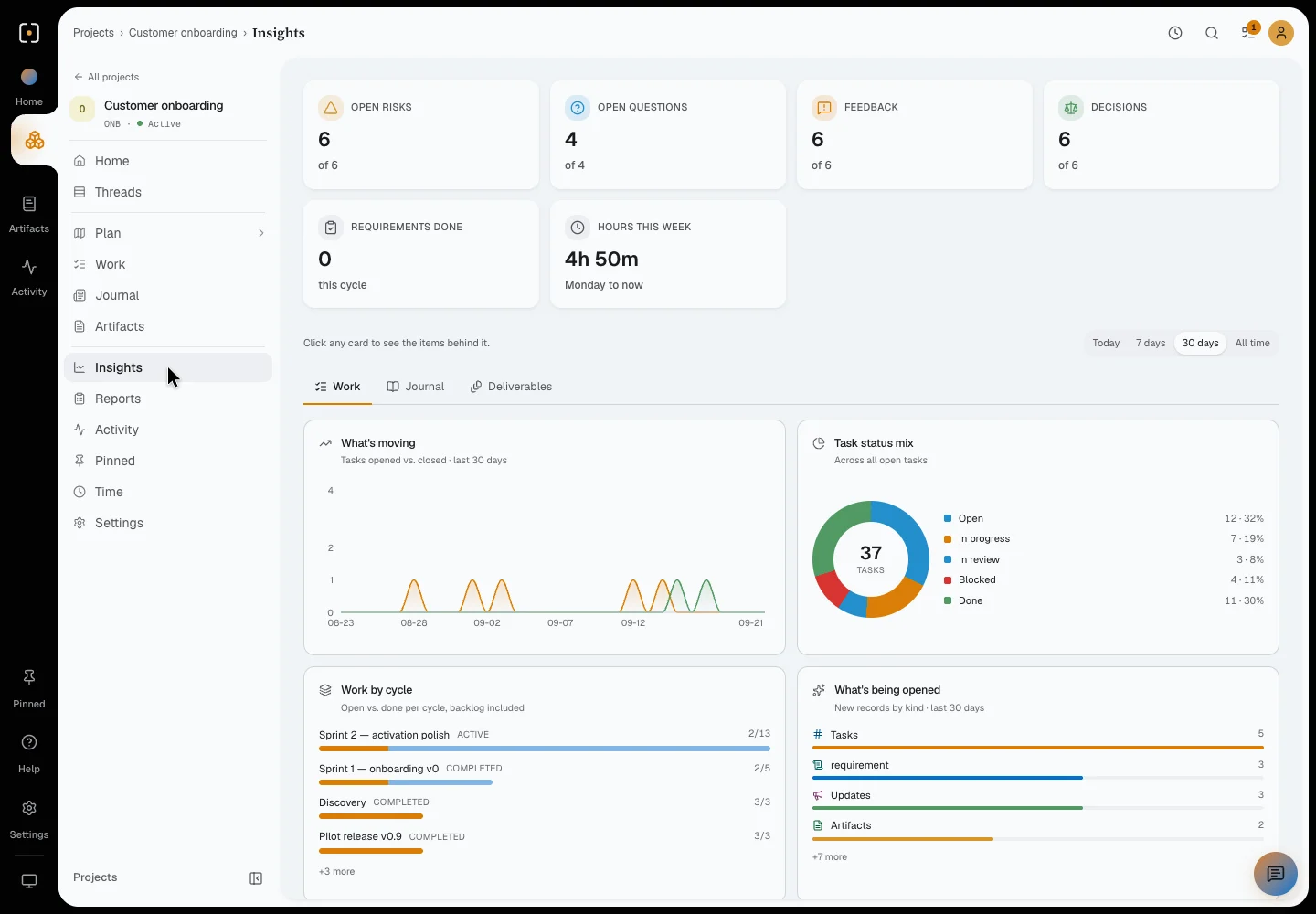
See what is moving, what is waiting and how work is distributed. Charts give the overview; the records behind them give you somewhere to go next.
Explore Work, Journal and Deliverables, with a time range for the charts that measure change.
Compare tasks opened and closed, the status mix, work by cycle and cycle burndown. Change the time range for time-based charts.
Explore Journal and Deliverables alongside Work. Open risks, questions, feedback and decisions stay visible in the project’s summary.
Supported chart cards open a detailed breakdown. Move from the overview to the items that need a conversation or a next step.
Keep Insights shows task trends, status mix, work by cycle and charts for Journal and Deliverables.
Recorded in Keep with sample data. Silent video.
Continue to Ask
Not only questions. File an idea, log a bug, open a task, see where someone’s hours went, share a document. Almost anything you do in Keep, you can do by asking the assistant you already talk to.
An idea becomes a requirement.
I have an idea — let customers export the per-person cost before checkout.Opens a requirement in the project
Log a bug: the export drops the last column.A bug, on the requirement it belongs to
Create a task for Priya to review the invite flow, due Friday.A task with an owner and a date
An update, without chasing anyone.
How is Customer onboarding going this week?Reads the cycle and the records in it
What did Alex work on yesterday?Recent activity, by person
What shipped in the last release?The release cycle and its notes
How long it took, and who worked on it.
How long did ONB-180 take?Time entries on one task
How much time did Jordan log on the export work?Time by person
Log 45 minutes on ONB-126.An entry against your own week
Open it, or share it on a link.
Open the export spec.Reads the artifact and its version
Share the project report as a link that expires Friday.A share link with an expiry
Post an update: the pilot is ready for review.An update the team can read
Example requests. A few owner-only actions stay in the app — creating a project, or emptying the recycle bin.
Connect your AI toolsWhere is Customer onboarding this week, and who has been on the export?
Sprint 2 — activation polish. Thirteen cards in view: three in review, two done, four of them blocked.
Two need someone: ONB-131, self-serve billing, waiting on the Stripe webhook and two days late. ONB-182, the export job queue, blocked and due Sep 30.
ONB-180, render the report as PDF, has eleven hours logged so far — the last two by Alex Rivera.
Idea: let customers export the per-person cost before checkout. File it for Customer onboarding.
Filed in Customer onboarding as a requirement. It is open, and it is waiting for you there.
ONB-188OpenThen: Create a task for it, for Priya.
ONB-189OpenHow it works. Your assistant connects to Keep over MCP: you sign in once, approve the connection, and from then on it acts as you, inside your own permissions. Set it up in Claude, ChatGPT and Gemini CLI, and in other assistants that support remote MCP connectors. Availability can depend on your client version and your team’s settings.
Work from your AI client with the project context your team sees. The connection gives access; the Keep plugin gives the agent guidance for how your project works.
Install and connect KeepUse a compatible coding or conversational AI client. The connection guide covers Claude, Claude Code, Cursor, VS Code, ChatGPT, Codex, Gemini CLI, Antigravity, Devin Desktop and Zed.
Sign in and approve the connection. Your existing permissions determine the records and actions the agent can access.
Ask your agent to inspect a requirement, pick up a task or save a document. Install the Keep plugin for its project workflows and guidance.
Not only questions: file an idea, log a bug, open a task, see where someone’s hours went, or share a document with a link. Almost anything you do in Keep, you can do by asking the assistant you already talk to — it acts as you, inside your own permissions. See what that looks like
Explore Keep’s dedicated tenancy, data isolation, security controls and Cloudflare foundation.
Bring your team and your AI agents into one shared workspace. Sign in to your workspace or request access.